Left panel
Scale
The fretboard scale box — 5 scale types, box patterns, and how it relates (loosely) to the KEY module.
The SCALE module shows a fretboard diagram of a scale, independent of (but seeded from) the current key.
Scale types
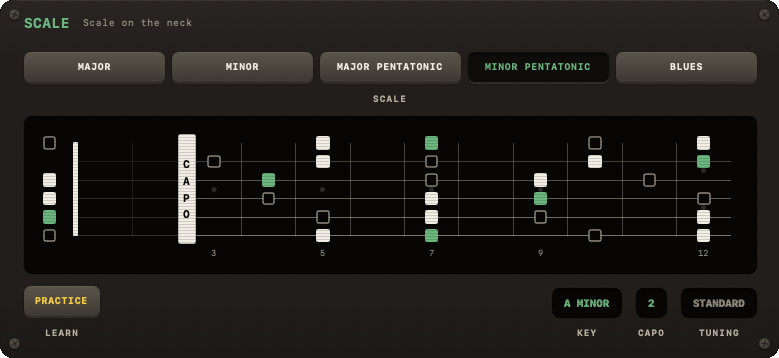
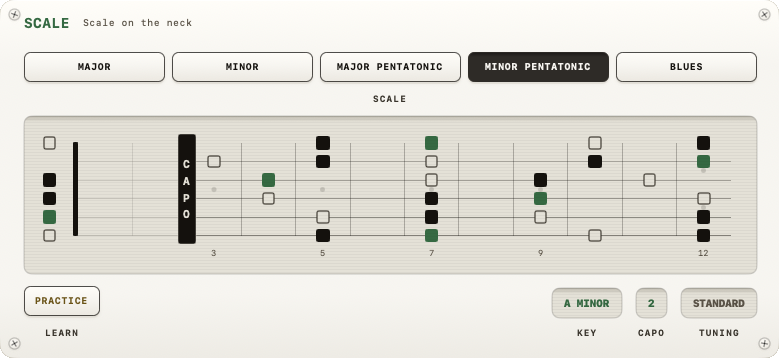
Exactly five, on one row of keys: MAJOR, MINOR, MAJOR PENTATONIC, MINOR PENTATONIC, BLUES. The underlying model actually supports many more scale types (modes, harmonic/melodic minor), but the UI intentionally restricts you to these five.
How it relates to KEY
The SCALE box does not automatically track the currently-playing chord. Its relationship to the KEY module is one-directional and easy to misread:
- Changing the tonic or mode in KEY resets the scale box back to the plain diatonic major/minor scale of the new key, discarding whatever scale type you had picked.
- Changing the scale type in this box (e.g. picking Blues) keeps the same root but does not touch KEY.
- Changing the tonic from inside the scale's big view does update KEY to match.
In short: it starts in sync with KEY, but picking a different scale type here breaks that sync until you touch KEY again.
Fretboard
A compact 12-fret neck. The root is a filled square in the KEY colour, the chord tones of the scale are filled in the text colour, the other scale notes are outlined; positions outside the scale are not drawn. Click the neck for the big view — a 24-fret neck with:
- a TONIC row of 12 notes,
- the same 5-way scale-type row,
- optional labels on the dots, under SHOW — DEGREES (scale degree) or NOTE NAMES, one at a time,
- and box patterns: clicking a root-note dot highlights just the ~4-fret window of notes around it (a "box" for practicing in position); clicking it again clears the highlight, and a capo or tuning change clears it too. The box is walked on the capo'd board, so with a capo on 3 a root click lights a proper box, not a scattering. ESC closes.
With a capo set, the neck is drawn from it: the frets behind the capo are dimmed, the capo is a clamp in the nut's ink past the outer strings that reads C A P O (since 0.74), the "open" strings in the gutter are the strings played at the capo, and the fret numbers stay the neck's own. Scale practice and Freddy use the same neck.
Nothing here plays a sound — box patterns and tonic/type selection are purely visual.
Under the board, the plate has CHORDS' footer (since 0.74): LEARN › PRACTICE on the left opens scale practice, a note-finding exercise built on this same scale/box concept; on the right KEY · CAPO · TUNING read the instrument as it is set — the same readouts stand in the big view's bottom row.