Right panel
Key
Tonic, mode, and the 8 guitar tunings — and how they change the rest of the band.
The KEY module sets the tonic and mode the whole session plays in, and which guitar tuning your chord shapes and the band's pitch assume. Collapsed, its header reads the key and the tuning.
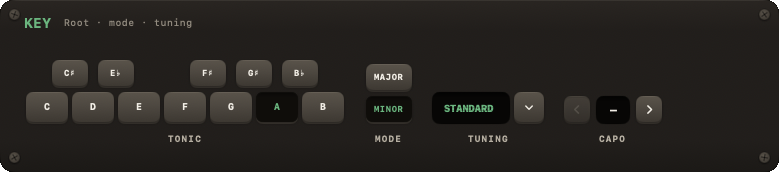
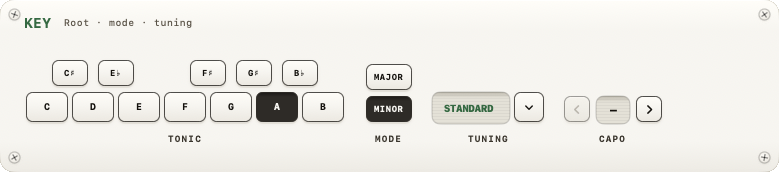
Tonic
A small keyboard: seven naturals on the floor, the five raised keys between them. Click a key to make it the tonic. A raised key is named the way its own key spells it — D♭ in major, C♯ in minor — so the label matches what the rest of the app prints once you land there.
Mode
Two options: MAJOR / MINOR.
Tuning
A picker with eight tunings, low string to high:
| Label | Name | Strings (low → high) |
|---|---|---|
| STANDARD | Standard | E A D G B E |
| DROP D | Drop D | D A D G B E |
| ½ DOWN | Half Step Down | D# G# C# F# A# D# |
| 1 DOWN | Full Step Down | D G C F A D |
| DROP C | Drop C | C G C F A D |
| OPEN G | Open G | D G D G B D |
| OPEN D | Open D | D A D F# A D |
| DADGAD | DADGAD | D A D G A D |
Capo
Since 0.71 a CAPO stepper stands beside TUNING (— at none, then the fret, 1–9). Clamp a capo on and set the fret here: the band and the chord detector follow you up by that much, while every chord, scale and diagram stays named the way you play it — the app keeps thinking in the shape key, exactly as for an E♭ tuning but upward. The module's header reads the key, the instrument (STD · CAPO 2) and, only while the shift is not zero, the sounding key: E MIN · STD · CAPO 2 · sounds F♯ MIN. Half Step Down with a capo on 1 shifts nothing, so the reading disappears.
The SCALE neck is drawn from the capo — a clamp that reads C A P O, and the plate's footer reads the fret beside KEY and TUNING — and so are scale practice — it hears what sounds, so a G shape with a capo on 2 is the A it expects — and the CHORDS diagrams. The SESSION line under the header reads the capo after the tuning, so every plate can read it. A song can carry its own capo, applied on load beside the tuning (see Song settings); the quickstart wizard has the same stepper.
Not affected, by design: the tuner (a capo does not change how the open strings are tuned), the chord diagrams and the grip lookup (the capo is a diagram's nut), the drums and the metronome.
How this propagates
- Changing the key updates the whole band and the SCALE box's default root.
- Changing the capo re-pitches the band and the chord detector upward by that many semitones; names, shapes and the tuner stay put.
- Changing the tuning only re-pitches the band for Half Step Down and Full Step Down — those two shift the whole band down by a semitone or a whole step to match your guitar. Drop and Open tunings keep the band at concert pitch; they only change which chord shapes are available on the fretboard.
- What the tuning does to the shapes is read in the CHORDS plate: its TUNING readout shows the tuning's name, and after it one word for anything but standard:
- Half/Full step down: TRANSPOSED — the shapes are transposed for that tuning
- Drop tunings: SOME MISSING — some shapes are unavailable
- Open tunings: NO SHAPES — the diagram section shows no diagrams at all in an open tuning